


Vineyards & Wine
Champagne is a drink become synonymous with name-day celebration or celebration. It enjoys a recognized prestige worldwide, including through the protection and defense of the very active label in time by the CIVC (Interprofessional Committee of Champagne wine).
Bounded by a law in 1927, the controlled designation of origin of the production area (AOC) Champagne covers some 34,000 hectares.
Located in France about 150 kilometers east of Paris, it includes 320 wines (communes) in five different departments:
Marne (66%),
Aube (23%),
Aisne (10%)
Haute-Marne and Seine-et-Marne.
The vineyard is divided into four major regions:
the Mountain of Reims,
Valley of the Marne,
Côte des Blancs
and Côte des Bar.
It has nearly 278,000 parcels with an average area of 18 acres. 17 villages historically receive the name "grand cru" and 42 villages of the designation "Premier Cru".
Champagne is produced mainly from three grapes: pinot noir N, N pinot meunier and chardonnay B. Champagne vineyards produces mostly sparkling white wines, with a wide range of wines (special or not), vintages and various bottles ..

En 1670, dom Pérignon (1638-1715), un moine cellérier de l'abbaye bénédictine d’Hautvillers, est le premier à pratiquer l'assemblage de raisins de différents crus et cépages, qui améliore la qualité du vin et en fait disparaître certains défauts.
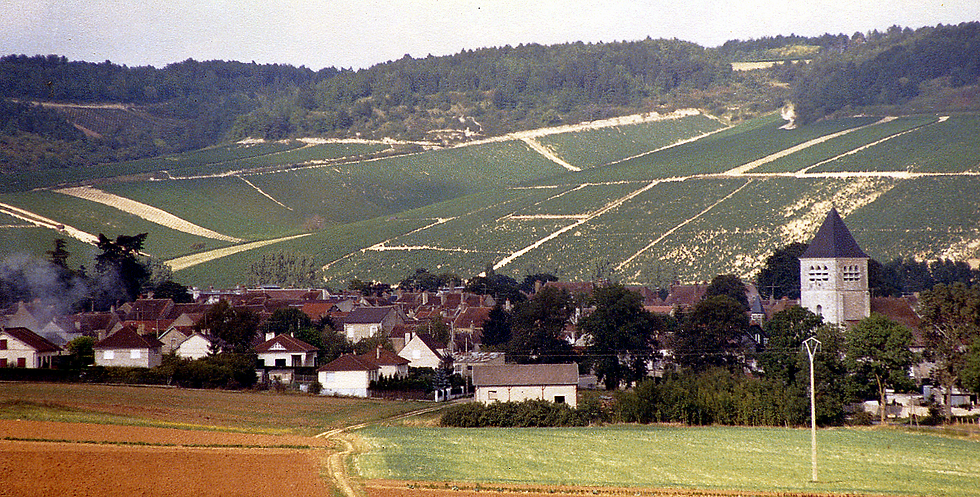
Vineyards in the Champagne region of France

Vue générale en été de la ville d'Épernay depuis le chemin de ceinture

A glass of Champagne exhibiting the characteristic bubbles associated with the wine

Corking a Champagne Bottle 1855 engraving of the manual method

Le Remueur 1889 engraving of the man engaged in the daily task of turning each bottle a fraction

Quelques bouchons de liège usagés de bouteilles de champagne


1915 English magazine illustration of a lady riding a Champagne cork (Lordprice Collection)

The Champagne vineyards map
In 1670, Dom Pérignon (1638-1715), a monk of the Benedictine abbey cellarer of Hautvillers, is the first to practice the blend of grapes from different vintages and varieties, improving the quality of wine and in fact some disappear defects. Moreover, during a pilgrimage to the Benedictine Abbey of Saint-Hilaire in Languedoc, he discovered winemaking method sparkling wines of Limoux, which has existed for over a century. Returned to his abbey of Hautvillers, Dom Pérignon experimented the method on the wines of the Champagne vineyards. It was also he who introduced the use of cork, held on the cylinder by a hemp string impregnated with oil, which allows the wine to keep its freshness and foam. Moreover, it is strengthening the bottle by adopting a thicker glass to prevent it explodes. Despite the efforts of the monk, the effervescence of wine remains until the empirical research of Louis Pasteur on fermentation in the nineteenth century. The chalk pits near the abbey were used to hold the champagne at constant temperature and humidity. Subsequently, other caves were dug into the chalk.
1845 The French Supreme Court rules in favor of a group of houses of champagne and bans use of the name "champagne" as a generic label for sparkling wines.
1882 Creation of the "Union of Champagne Wines Trade" (now the Union of Champagne Houses).